Summarized by Ceren Bilacan, Nexus Points Doc Research Team, Original research by Akgün İlhan
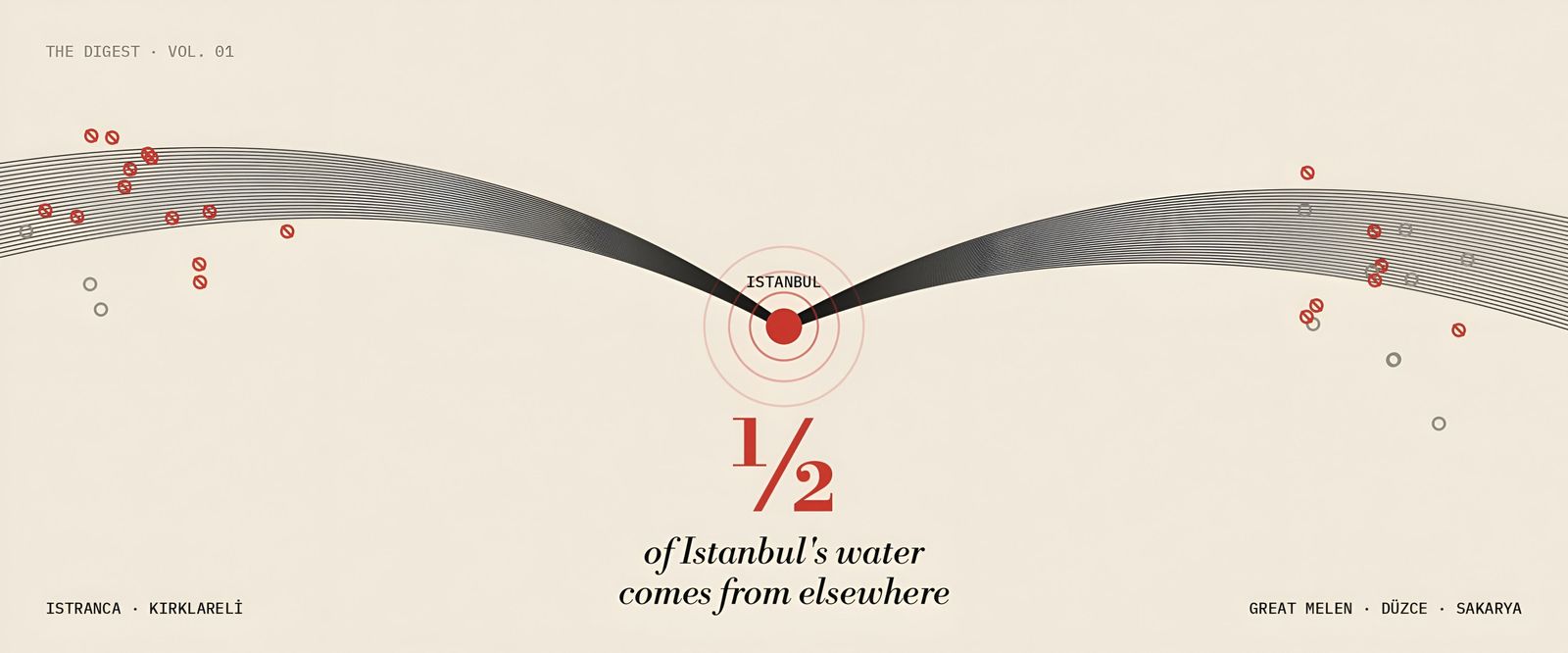
It is transferred from distant river basins through massive infrastructure projects: the Istranca and Great Melen systems. They were built to secure a growing metropolis against drought. On paper, these inter-basin water transfers promise resilience: more storage, more supply, more stability. A technical solution to a climatic problem.
What remains largely invisible is the environmental injustice that makes this model possible.
To keep the city flowing, rural regions in Kırklareli, Düzce, and Sakarya have been transformed into sacrifice zones. Agricultural lands were submerged or restricted under protection regimes. Hazelnut orchards were cut down. Entire villages were evacuated. In the Melen case, around five thousand people were displaced. Cemeteries were relocated. Communities were broken apart. One villager described the imbalance in a striking metaphor: "Istanbul was a giant whale, and our village was just a little fish."
Compensation was paid. But compensation was temporary. The loss of land, livelihood, memory, and social networks was not.
This is where the environmental justice lens becomes crucial. The injustice is not only about money. It unfolds in layers: recognition, participation, and distribution. Rural communities were informed, yet their ability to influence decisions was limited. Public meetings took place, but the projects were framed as inevitable and justified by national interest and urban necessity. When communities are not fully recognized as equal stakeholders, participation becomes procedural, and costs are distributed asymmetrically.
Map showing Istanbul's water infrastructure from Kırklareli to Düzce, including the Istranca System and Great Melen System Figure 1 (from article). Istanbul's water infrastructure from Kırklareli to Düzce Istanbul benefits from uninterrupted water, while the burdens are absorbed elsewhere. Urban growth remains non-negotiable. Rural landscapes absorb the ecological and social cost.
And the story does not end there.
Transporting water across long distances requires enormous energy—in fact, energy accounts for more than 60% of the cost of transferred water. Real financial costs are softened through politically controlled water pricing, masking the true cost of extraction. As climate change intensifies drought across the Marmara region, donor basins may themselves face water stress. What was presented as a permanent solution begins to look like a redistribution of vulnerability across the region.
Water insecurity is not eliminated. It is displaced.
Two people fish beside the concrete structure of the Melen Dam reservoir Two people fish beside the concrete structure of the Melen Dam reservoir. Photo by Bradley Secker The article ultimately asks a structural question: Who is allowed to grow, and who is expected to sacrifice? If water security depends on turning certain territories into sacrifice zones, then the crisis is not simply hydrological—it is structural.
İlhan, A. (2025). Expanding Water, Deepening Injustice: How Istanbul’s IBWT Projects Reshape Urban and Rural Lives. YILLIK: Annual of Istanbul Studies, 7, 75-101. https://doi.org/10.53979/yillik.1697624
Click here to read the full article